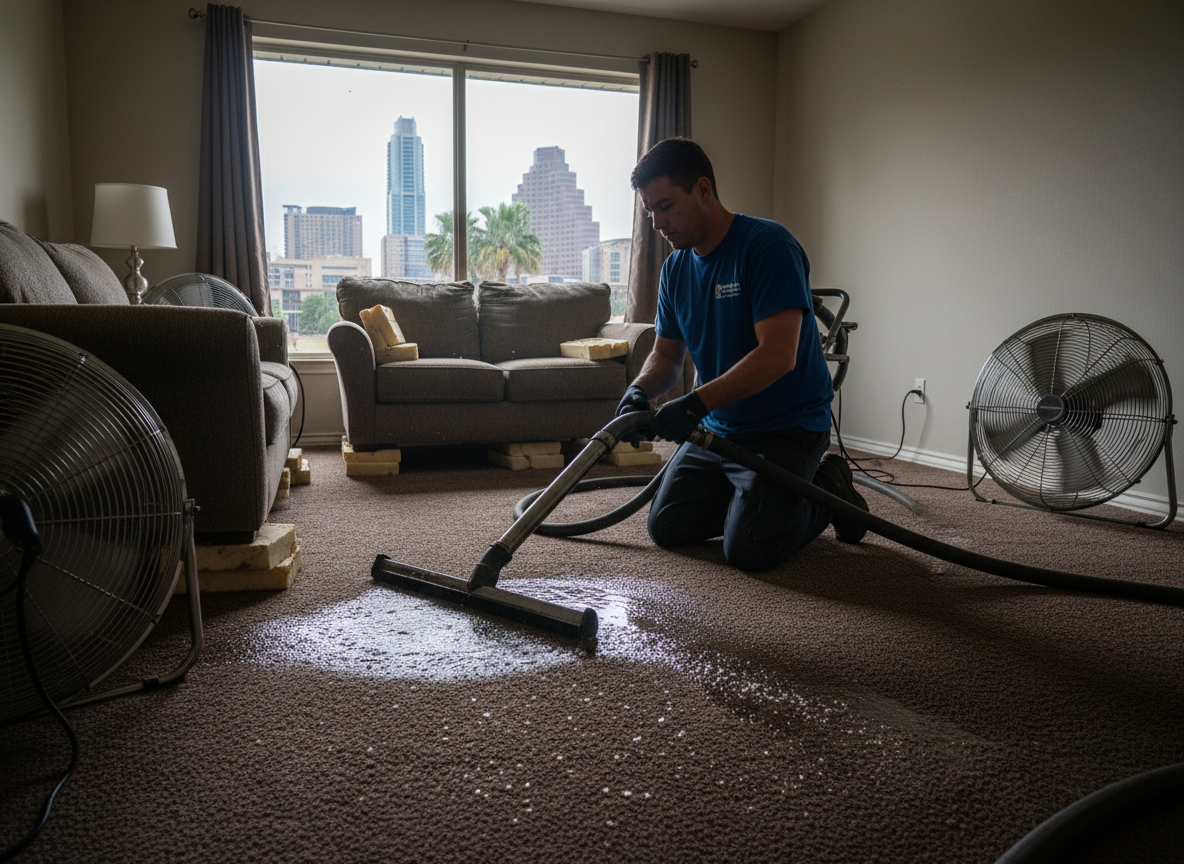
Austin summers bring high humidity that slows natural drying after any water event, so extraction must pull standing water and trapped moisture from wood subfloors and drywall before mold colonies form. Homes built before 1980 in Hyde Park and Clarksville often have pier-and-beam foundations with limited crawlspace access, requiring pumps and wands that reach under floor joists without tearing out entire rooms. Travis County soil swells during spring rains, pushing water against slab edges in Mueller and Barton Hills, which changes how crews angle extraction tools to avoid pushing moisture deeper into the structure.
East Austin and South Congress properties frequently sit on older clay sewer lines that crack and back up during heavy downpours, sending gray water into finished basements or laundry rooms. Extraction here includes separating clean and contaminated water streams so disposal follows Travis County health rules. Crews also watch for hidden pockets behind built-in cabinetry common in 1950s Clarksville cottages, where a missed pocket can reappear days later as warped trim.
Westlake and Zilker homes near Lady Bird Lake face occasional flash flooding that carries sediment into HVAC returns and under stairwells. Extraction teams use truck-mounted units with 200-plus CFM airflow to handle these larger volumes quickly, then switch to air movers placed at floor level to chase moisture out of the limestone and tile that dominate local flooring. Nearby cities such as Round Rock and Pflugerville see similar patterns on newer builds, but the older stock in central Austin demands slower, more methodical passes to protect original plaster and hardwood.
Technician insight
In Austin the thing that catches most people out with water extraction is how fast humidity re-wets surfaces after the pumps leave, especially in 1950s pier-and-beam homes in Hyde Park where crawlspace vents are often blocked by landscaping.
South Congress laundry room backup
A cracked clay line under a 1960s South Congress duplex sent gray water into the laundry room and under the adjacent hardwood. Extraction pulled water from the slab edge and pad, then equipment was staged in the crawlspace to keep humidity from pushing moisture back into the joists. Three days later moisture readings were within range and the owners avoided floor replacement.
Water Extraction Services Services We Offer
✓Emergency Flood Extraction
Rapid removal of standing water from living spaces after storms or pipe bursts using portable and truck-mounted pumps sized for Austin rainfall rates.
✓Carpet and Pad Extraction
Lift and extract water from carpet and underlying pad in one pass to prevent mildew growth common in humid Travis County summers.
✓Appliance Leak Extraction
Targeted removal of water from washing machines, water heaters and refrigerators that leak onto slab or pier-and-beam floors in older East Austin homes.
✓Crawlspace Water Extraction
Pump and dry water from under pier-and-beam homes in Hyde Park and Clarksville where limited access and high humidity make complete removal difficult.
✓Storm Sediment Extraction
Clean removal of silt and debris left by Lady Bird Lake or Barton Creek flooding before it settles into subfloors in Zilker and Barton Hills.
Water Extraction Services Cost in Austin, TX
| Service | Typical Range | What Affects It |
|---|---|---|
| Small room extraction | $250–$450 | Single room under 200 sq ft with clean water source |
| Crawlspace extraction | $600–$1,200 | Pier-and-beam access and sediment load |
| Multi-room flood extraction | $800–$2,000 | Several rooms plus hallway after storm |
| Appliance leak extraction | $200–$400 | Localized water from washer or water heater |
| Sediment removal add-on | $150–$300 | Extra pass needed after lake or creek flooding |
Ranges are typical for Austin, TX and confirmed with an exact written quote before any work starts.
How it works
- 1
Site Assessment
Walk the affected rooms and check moisture levels in floors, walls and cavities common to Austin housing stock.
- 2
Water Removal
Deploy pumps and extraction wands to pull standing and trapped water while separating clean versus contaminated streams.
- 3
Targeted Drying Setup
Place air movers and dehumidifiers at floor level and in crawlspaces to counter Austin humidity and prevent secondary damage.
- 4
Final Moisture Check
Re-test all surfaces and document readings before equipment removal to confirm the structure is dry.
Pricing
Prices vary by volume of water, access difficulty, and whether the source was clean or contaminated.